The furnace has been running, the first hard freezes are here, and you found water in the attic. Frost on the underside of the roof deck. Drops on the tips of the roofing nails. A damp spot on the ceiling. It looks like a leak.
Often it is not. Frost or droplets across many nail tips, on a cold dry day or as that frost melts, usually means condensation. A leak is usually one spot, near a chimney, vent pipe, valley, skylight, or flashing, and it lines up with rain or melting snow.
Why Springfield attics do this in the fall
Warm air holds more moisture than cold air. When it leaks out of the house and hits a cold surface, it becomes water, frost, or ice. University of Missouri Extension's condensation guide says vapor condenses on a cold surface, such as a poorly insulated ceiling.
In a vented attic those surfaces are the roof deck and the nails through it. The nails cool first, so a bead can hang on the tip while the shingles are fine. The U.S. Department of Energy's Building America Solution Center says that deck often sits below the dew point. In a cold snap that moisture often shows up as frost. Trouble starts when the frost melts and the water sits long enough to mold, rot wood, or rust fasteners.
The moisture usually starts downstairs. MU Extension says a family of four can add more than 6 gallons of water to indoor air in a day. Their list totals about 6.7 gallons. An unvented dryer alone is 26.4 pounds. They recommend about 35 to 50 percent indoor humidity in the heating season.
That air reaches the attic through the hatch, recessed lights, plumbing stacks, wiring holes, and the chimney chase. Natural Resources Canada's Keeping the Heat In says to look during or just after a cold snap, when condensation shows up as frost, and again during or just after a rain, so you can tell inside moisture from outside water.
A simple way to tell them apart
Stay off the roof. Two trips with a flashlight are enough: one in a cold snap, one in a rain.
- Where it is. Frost or droplets on many nails, across a slope, point to condensation. Interlock's knowledge base, written for metal roofs, says moisture like that is condensation, not a roofing defect. The guides above describe the same pattern under asphalt shingles. One streak or one matted patch, under a chimney, pipe, valley, or skylight, points to a leak. NRCan points to water marks on the sheathing or along a rafter when the water came from the roof or the flashing.
- When it shows up. A cold, dry day, or the morning the frost melts, fits condensation. Rain, or snow melting on the roof, fits a leak.
- Other clues. Rusty nail tips fit repeated condensation. MU Extension and the Department of Energy both note that it can corrode fasteners. Rust alone is not a hole in the shingles. A bath fan, kitchen fan, or dryer that dumps into the attic is feeding it. Those ducts have to end outdoors, MU Extension says, and a dryer should never vent indoors. Insulation packed into the soffits blocks the intake, and that airway has to stay clear. Lift discolored insulation. NRCan says air leaks stain it. One soaked column is a leak. Dampness across the attic after a freeze is condensation.
A little frost can be normal. NRCan says some is expected. Heavy frost, wet insulation, a ceiling stain, or mold is the point to act.
What actually fixes it
If the moisture is widespread and it does not show up with the rain, the fix is in the attic. On a metal roof, Interlock says this is not a roofing defect. The cause is ventilation, insulation, or vapor control, and a roof repair does not cure it.
Exhaust outdoors, then seal the ceiling
Run the bath fan, the kitchen fan, and the dryer all the way outside, and check that the dryer hood moves. Then seal the ceiling. NRCan says vents will not prevent condensation or fix air leaks, so seal the hatch, wire holes, plumbing stacks, can lights, and the chimney chase first. The Department of Energy treats that air barrier as the main control, because insulation on the attic floor does not warm the deck. More insulation, with the holes left open, does not stop the moist air. Once the holes are sealed, MU Extension still recommends about R-49 at the ceiling or roof, though an older house may not get there. See insulation cost in Springfield if you are pricing that work.
Balanced vents, and the humidifier
Bring air in at the soffits and out at a ridge vent or another high vent. NRCan says about half the opening should be soffit vents and half should be gable, ridge, or roof vents. The Department of Energy says the exhaust area should not exceed the intake. With no vapor barrier, MU Extension's rule of thumb is 1 square foot of vent per 150 square feet of attic. The Department of Energy notes that residential codes commonly use that ratio and sometimes allow up to 1 per 300. Keep a gap at the eaves so the insulation stays out of the soffit: about 2 inches in the Department of Energy guide, and about 1.5 inches in the ice-dam advice from Bob Schultheis at MU Extension.
Do not add a powered fan to skip the sealing. NRCan says not to automatically increase ventilation, because a fan can pull house air into the attic. If you run a humidifier, stay near 35 to 50 percent, use the fans when you bathe and cook, and cover pots when you boil.
The same air leaks make ice dams
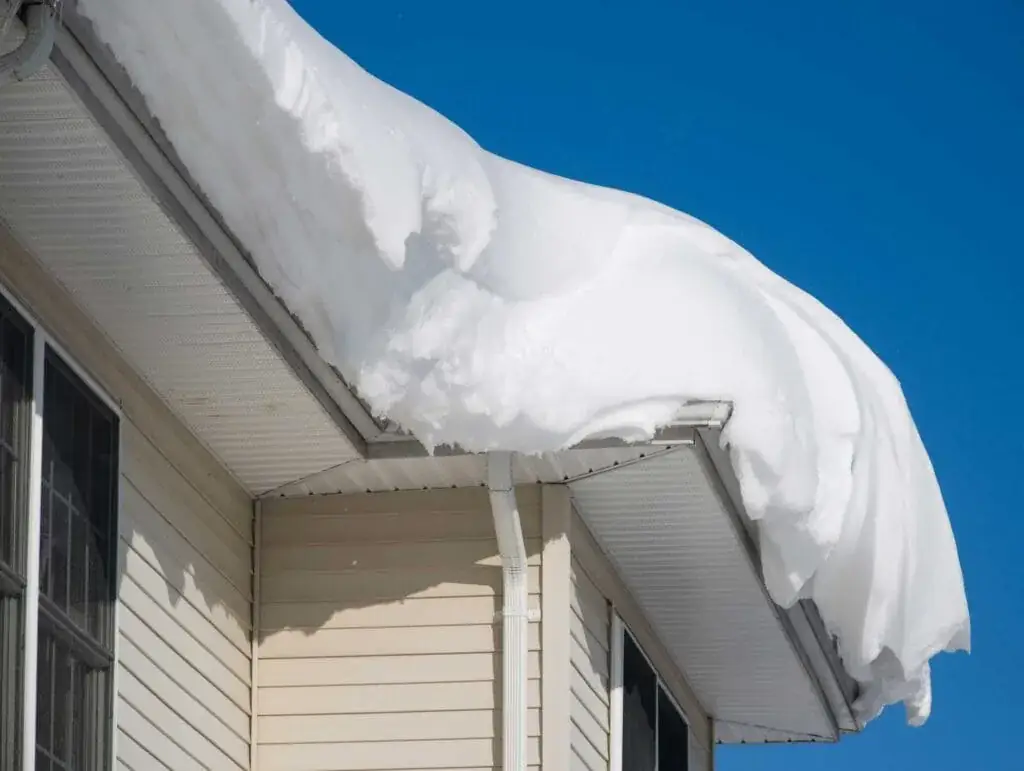
That warm attic air can melt snow on the upper roof while the eaves stay frozen. MU Extension's ice dam note explains the rest. Melt water refreezes at the overhang, ice builds, and water can back under the shingles. Schultheis says the backup can damage shingles, gutters, insulation, ceilings, framing, and fasteners, and it can grow mold. Plug the gaps at vents, wiring, lights, and chimneys, insulate the ceiling and roof to about R-38 to R-49, and keep the attic cold and vented.
NRCan's prevention line is the same: seal the air leaks and insulate. The yard-level winter walk, gutters included, is in what to check on your Springfield roof before winter. The Woodland Heights winter post mentions attic condensation in one short paragraph. This check goes further.
When it really is the roof
It is the roof when the water has one address. A stain at a chimney, pipe boot, valley, skylight, or wall flashing. It tracks rain or melting snow, including water held behind an ice dam. Missing or creased shingles at that spot, or nail heads exposed on the surface. Insulation wet in a column and dry beside it.
That is a roof repair. We will tell you if a repair will hold or the deck needs more. If the whole field is worn out, that is residential roofing, and we will say so. A low-slope commercial building does not have this attic. For that roof, start with commercial roof maintenance. We would rather report a sound roof and an attic that needs sealing than sell a roof you do not need.
Questions we hear once the furnace is on
Is a little frost on attic nails normal?
A light frost on a bitter morning can be. NRCan says some frost is expected. If it clears and the insulation stays dry, leave it. Heavy frost, wet insulation, or a mold smell is a different story.
Will my homeowners insurance cover condensation damage?
It depends on your policy. We cannot tell you what your carrier will pay, and we will not guess at the rules. Call your agent, describe what you found, and ask. An inspection that names condensation or a flashing leak gives you something concrete to describe.
Should I just add more vents?
Not first. Clear the soffits, pair them with a high vent, and seal the ceiling before you add hardware. A powered fan can pull house air into the attic and make the wetting worse.
Can I fix this myself?
From the attic floor, you can check a bath-fan duct, turn the humidifier down, and weatherstrip the hatch. Stay off the roof. MU Extension says clearing ice and snow up there is dangerous. Call if the ceiling is stained or you still cannot tell the two apart.
Want a second set of eyes on the attic?
Titan Roofing will look at the attic and the roof and tell you which problem you have. If a flashing or a shingle is letting water in, we will show you and give you a free estimate. Call Springfield at (417) 815-4833 or Pleasant Hill at (816) 307-0657. Email support@titanroofingpros.com, or contact us to schedule.

Titan Roofing is a family-owned roofing company serving Springfield, Kansas City, Columbia and the surrounding Missouri communities with residential and commercial roof repair, replacement, gutters and siding. Questions about your roof? Ask us, or call (417) 815-4833.